Written By Mya Slawiak
As an Online Student located around 200 miles from our campus, I wondered what I was able to offer for interesting subjects that would not only tell a bit about myself, but also share a bit of my love for the history of our state and my home. This week, I decided to dive into a bit of my local history, or more specifically The Erie Canal. A 363-mile long man made waterway that many hear about growing up in our state, but most do not realize the benefits it has brought to our economy, or the development it has gone through in the 209 years since its construction.
Where The Story Begins
In the 1790s, before the Erie Canal was built, the area known as the Oneida Carry was a fairly difficult area to transport cargo and people. While we had many lakes and rivers, none made travel easier across the state in a meaningful way. The areas where the canals were meant to be dug were ideal for the plan Governor DeWitt Clinton had formed, but were also inhabited by the Haudenosaunee (Iroquois) people, who the Governor predicted that “before the passing away of the present generation, not a single Iroquois will be seen in this state.” The Haudenosaunee people were then displaced to make way for construction. Many Natives still reside in New York, and we have many tribes that now have booming business ventures and are incredibly active in local communities, but many are no longer near their ancestral homelands as a result of this displacement. On the 4th of July, 1817, in Rome, New York, the starting point for what we know today as The Erie Canal was dug. At the time it was called ‘Clinton’s Big Ditch’ and was the turning point for our state’s ascent to leading our nation in population, industry, and economic strength, and marked New York as ‘The Empire State’. I am fortunate enough to live a short 15 minute drive from this location and while sadly, the historic Erie Canal Village that is located in the same spot is closed to the public, we are still able to visit the marker and see a bit of our history. Many know the canal to be exactly what it is, a waterway that stretches the length of New York State, and it was a really cool thing to happen to our economy, but it was far more than a way to send boats for long trips.
Why Did We Need It?
The Canal was built to reduce the time and cost of transport of people and goods from the east coast to the great lakes, before its construction, it would take months for people to travel across New York, and the cost of transporting cargo over land was far more expensive than by waterway. The topography of the Mohawk Valley area was ideal for a canal, and essentially became the path the Erie Canal would follow east to west from Lake Erie to the Champlain Canal, a waterway that runs north to south from Lake Champlain to the Hudson River, which began construction around the same time as the Erie. The canal also utilized 83 boat locks, a technology that was used to raise or lower a boat through the waterway as the landscape changed through the state. The difference in elevation between Albany and Buffalo is approximately 571 feet and would otherwise require far more excavation if it did not have the locks.
The ‘New’ Canal
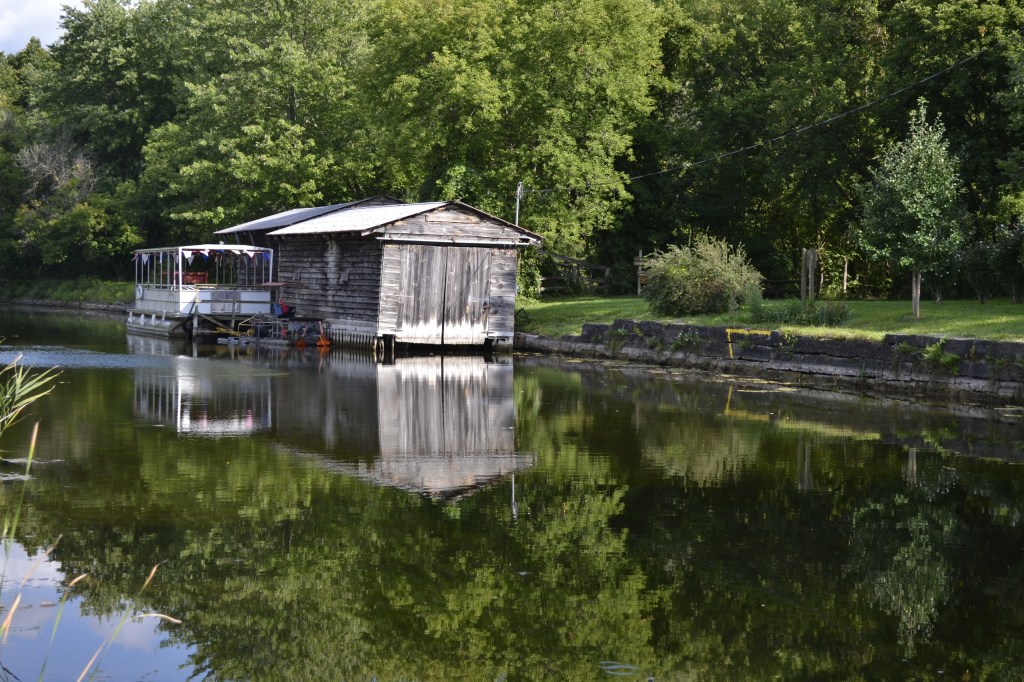
The original canal was utilized from 1817 to 1905, though went through 2 different enlargements to accommodate larger boats. Though on November 3rd, 1905, 75% of New York voters aided in the decision to start construction on the Erie Barge Canal. At this time, canal traffic had become less prominent and many were utilizing trains as a mode of transportation for themselves and goods for further distances. The new Barge Canal System was going to be enlarged in both width and depth, and was meant to accommodate self propelling or tug boat led vessels. At the time of this construction, concrete was a fairly new material and was going to be used to replace the cut stone in the construction of the new locks. Instead of the original 83 locks that were used in the original waterway, the new Barge Canal would hold 37 locks from end to end, likely due to the slight shift in location in some spots from the original canal and the enlargement of the structures covering more area than was possible before. More than half of the original canal was abandoned in some form in favor of the new system, though the longest preserved section still runs about 35 miles long from DeWitt to Rome, NY and follows alongside State Route 46 for a portion of it, making it a daily sight for locals to see often.
Today, the Erie Barge Canal does not see much commercial use, though has become a staple in New York local leisure and history, though very recently was used to bring a 60,000 pound acrylic panel for a shark tank from Italy meant for the Crouse Health Harborview Aquarium that is under construction in Syracuse, NY. While we do not utilize water travel in the ways we used to, the Erie Canal remains a vital piece of our history. Though it was constructed through less than ideal methods and displaced many people, even those who aided the American side during the Revolution, the Erie Canal gave many New Yorkers hope for a better life and economy.
Sources Cited:
National Park Service, 2026 Erie Canalway National Heritage Corridor
History and Culture
https://eriecanalway.org/learn/history-culture
National Park Service, 2026 Erie Canalway NAtional Heritage Corridor
Fast Facts
https://eriecanalway.org/learn/history-culture/fast-facts
Maready, Ashley, Why Was The Erie Canal Constructed?,
2025 Erie Canal Museum
https://eriecanalmuseum.org/erie-canal-constructed/
New York State Archives Partnership Trust
Barge Canal
https://www.nysarchivestrust.org/exhibits/erie-canal/barge-canal
CNY Central, 2026, June 19
Nichols, Charlie
https://cnycentral.com/news/local/60000-pound-aquarium-panel-arrives-in-syracuse-via-erie-canal


Leave a Reply