By Christopher Kinsley
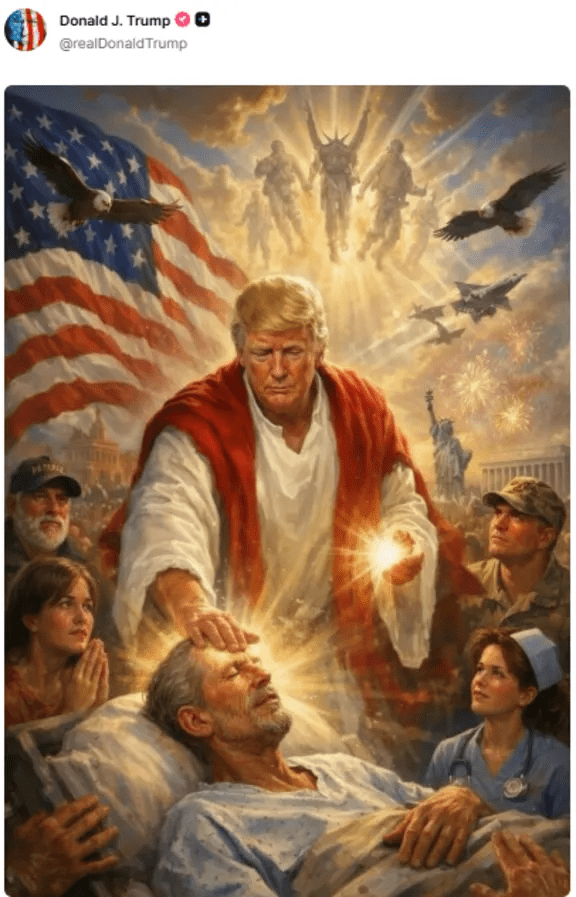
President Trump created controversy earlier this month when he posted a long message to Pope Leo and shortly after posted an image of himself dressed as Jesus Christ. The backlash to the Ai image was immediate and came from Christians of multiple denominations, resulting in the posts removal the same day it was posted. Trump has since claimed that the image was attempting to depict him as a Red-Cross doctor giving medical aid, despite a lack of the famous red-cross itself. Instead, the image depicts Trump wearing robes commonly seen on Jesus, with rays of light emanating from his hands as one is placed on a sick man’s head.
This isn’t the first time Trump has upset Catholic voters; in 2025 he posted an Ai generated image of himself wearing the papal robes shortly after the death of Pope Francis and during the conclave which was to elect Pope Leo. This was also met by fierce criticism, yet despite this Trump was able to secure 55% of the Catholic vote in 2024, according to the Pew Research Center. This begs the question; will the recent set of controversies affect Trumps successor? Both of his preposed successors are Catholics, and JD Vance has joined the President in his condemnation of Pope Leos’ anti-war statements.
Prominent Catholic supporter of Trump, Michael Knowles, posted on X his desire to see the Ai image of Trump dressed as Jesus taken down. Knowles went on to affirm his continued support for Trump despite his treatment of Pope Leo and cited Catholic doctrine to attempt to justify Trump to Catholics. Knowles supported the Presidents right to disagree with the Pope on political matters or prudential judgments. Most Catholics would find themselves disagreeing politically with at least one Pope in history and they could rely on the same argument. However, many online discussions center around the personal beliefs of the administration as voters come to expect certain things from their candidate. The question focuses less on the validity of a Catholic to vote for either party, but to the sincerity of JD Vance’s conversion as the assumed successor to Trump, as well as the reality of voting in a President who is going to publicly criticize the Pope. Even if a faithful Catholic is permitted to disagree with the Pope, publicly condemning the Pope is seen as distasteful and concerning by many Catholics.
The quiet fear many Catholics hold is rooted in our country’s history of identity politics, that of anti-Catholic discrimination. Many Americans are unaware that our country at one time persecuted the Catholic church using much of the same rhetoric seen today to justify the proposed mass deportations. It was said in political slogans and state charters that Catholics had “dual loyalty” to the U.S.A and the Roman Pontif, which led to the prohibition of Catholics from holding public office, as well as anti-Catholic propaganda in public school curriculums. If the Republican party begins to rally against the Pope, it’s easy to see how they may also reignite this old hatred.
Regardless, the only two Catholic Presidents in American history have been John F. Kennedy and Joe Biden, both democrats. If Republicans lose the Catholic vote, they may not be able to get it back, and what are the odds that the third Catholic President in U.S. history is voted into office without the help of the Catholic vote?


Leave a comment