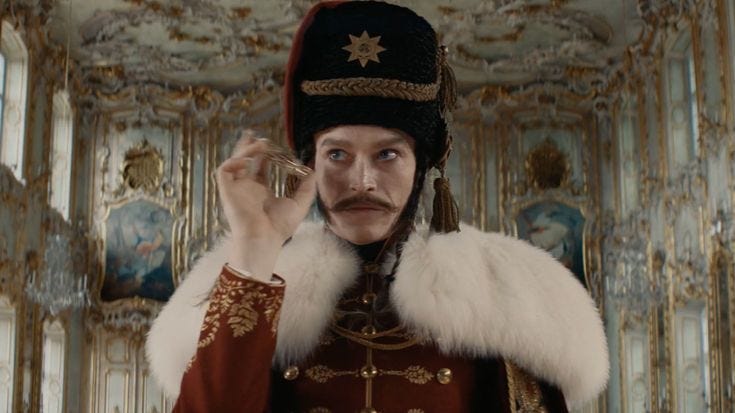
Luc Besson’s modern take on Dracula trades gothic romance for raw intensity, anchored by a standout performance from Caleb Landry Jones. His feral, magnetic portrayal offers a sharp contrast to Francis Ford Coppola’s classic 1992 adaptation — and gives Besson one of his most compelling characters in years.
By Shen Pe Utz Taa-Nete
Luc Besson’s 2026 rendition of Dracula arrives with the kind of ambition that has always defined his career: a taste for spectacle, a fascination with outsiders, and a willingness to bend genre until it fits the emotional world he wants to build. But what truly anchors this film — what gives it teeth — is Caleb Landry Jones. His performance as Dracula is so strange, magnetic, and unsettling that it becomes the gravitational center of the entire movie. I walked out of the theater smitten, not with the Count himself, but with the sheer commitment Jones brings to every frame. His career has been sharpening for years, and here he finally gets a role wild enough to match his range.
Besson’s film doesn’t try to mimic Bram Stoker’s novel beat for beat. Instead, it feels like he’s chasing the emotional undercurrents — desire, loneliness, corruption — and translating them into his own cinematic language. This is the same director who gave us Léon: The Professional, La Femme Nikita, and Lucy, films that mix style with moral ambiguity. And while I’ve never been a devoted follower of his work, I’ve always held a soft spot for The Fifth Element, mostly because Chris Tucker’s performance as Ruby Rhod remains one of my favorite comedic turns in sci‑fi. That movie showed Besson at his best: bold, colorful, and unafraid to let an actor steal the show.
In Dracula, he gives that spotlight to Jones — and Jones devours it.
Caleb Landry Jones has always been the kind of actor who disappears into roles, sometimes to the point of discomfort. From Get Out to Nitram, he’s built a career on characters who vibrate with internal tension. But as Dracula, he finally gets a character whose mythology is big enough to hold all that intensity. His Dracula is not the aristocratic seducer we’ve seen in earlier versions. He’s feral and elegant at the same time, a creature who seems half‑starved and half‑divine. Jones plays him like someone who has lived too long and felt too much, and the result is a performance that’s both terrifying and strangely tender.
Comparing Besson’s film to Francis Ford Coppola’s 1992 Bram Stoker’s Dracula is inevitable, because Coppola’s version still casts a long shadow. I’ve enjoyed many of Coppola’s films — The Godfather, The Conversation, Apocalypse Now — and his take on Dracula is one of those rare adaptations that feels operatic in scope. Coppola leaned into excess: the costumes, the practical effects, the theatricality of Gary Oldman’s performance. His film is lush, romantic, and unapologetically gothic. It treats Dracula as a tragic lover, a man cursed by grief.
Besson goes in the opposite direction. His world is colder, more modern, stripped of the Victorian grandeur that defined Coppola’s vision. Where Coppola’s Dracula is a doomed romantic, Besson’s is a creature of instinct and hunger. The contrast between the two films reveals how flexible the Dracula myth can be. Coppola’s version seduces you; Besson’s stalks you.
Thematically, Coppola’s film is about love surviving across centuries. Besson’s is about the cost of immortality — the erosion of self, the violence required to keep existing. Even the visual language reflects this divide. Coppola’s film is drenched in reds and golds, every frame designed like a painting. Besson’s palette is harsher: blues, grays, and the occasional burst of blood‑red that feels more like a warning than an invitation.
And yet, despite these differences, both films hinge on the charisma of their Draculas. Gary Oldman gave us a Dracula who could shift from monstrous to seductive in a single breath. Caleb Landry Jones gives us a Dracula who feels like a living wound — raw, unpredictable, and impossible to look away from. If Oldman’s performance was theatrical, Jones’s is psychological. He digs into the creature’s loneliness, his rage, his fractured sense of identity. It’s the kind of performance that makes you rethink a character you thought you already understood.
Besson’s direction doesn’t always match the depth Jones brings, but when the film works, it works because the actor at its center refuses to play Dracula as a cliché. Instead, he plays him as a being who has outlived his own myth. That choice alone makes this adaptation worth watching.
In the end, Besson’s Dracula isn’t perfect, but it’s compelling. It’s a film that takes risks, some successful, some uneven, but all anchored by a performance that feels like a career milestone. I may not be a longtime Besson devotee, but this film reminded me why I loved The Fifth Element: when he finds the right actor, he knows how to let them burn bright.
And Caleb Landry Jones burns brightest of all.


Leave a comment