By Dre Shaw
In 1976, a year that produced some of the greatest albums in the history of pop music, there are two releases that stand in such stark contrast it’s almost comical.
The first is Hotel California by The Eagles, released in December of that year. It was an album that was an immediate critical and commercial success, and continues to this day to be one of the top ten best-selling albums of all time, outpaced by Michael Jackson, AC/DC, Whitney Houston, Pink Floyd, and the Eagles’ OWN best hits compilation. It was a high-budget, harmonically dense, carefully crafted record with a title track that still gets radio-play today.
It is also a deeply, deeply boring piece of music history.
Well-made? No doubt. Important and influential? Certainly. But it is also a pop-rock record made at the height of the recording career of a band that had already defined the sound of L.A. soft-rock – itself a genre essentially designed for ease of consumption – and the magnum opus of the exact style that Punk Rock sought to bring down.
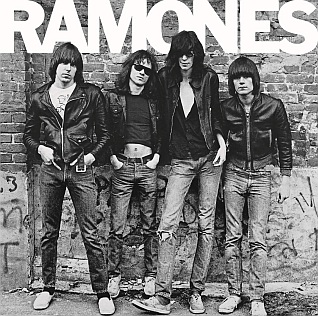
Now, rewinding to April 23rd of that same year, we see the release of the Ramones’ eponymous debut.
Were they the first punk band? Not by a long shot. The most politically intelligent? By no means. The most technically proficient? Absolutely not.
But they were a band that was deeply, deeply efficient.
Using a budget of just $6,400, they smashed together MC5’s Kicking of Jams, the Bubblegum Pop of the decade prior, the wild energy of the Stooges, the gritty NYC ethos of the Velvet Underground, lyrics about child abuse and love and World War II, leather jackets, CBGB notoriety, and the perfect simplicity of minimal power chords to make 14 shots heard round the world.
It’s a 29 minute album in which not a single song runs for even 3 minutes – an album in which the simple verse-chorus-verse structure reigns supreme, and the foot is never taken off the distorted, up-tempo gas pedal for a single second. It was, in every single sense of the word, Rock and Roll.
It was what the last two decades of pop preceding had evolved from, and the exact template on which it could be built again; the purest distillation of minimal structure and maximalist energy.
The Ramones became the dark, fun, gritty, intense, free-spirited center of the New York Punk scene, and in the wake of their success, numerous bands were given opportunities to rise to prominence – both those who wanted to continue what they started, and those who wanted to respond to what they felt was a quick stagnation within the scene itself.
In team continuance we had contemporaries like The Damned and The Clash, who would expand beyond the lyrical and compositional simplicity and begin to dip their toes into new styles, as well progenitors of the more-melodic side of the grunge and pop punk movements that would define Rock in the late 80’s and early 90’s like Nirvana and Green Day.
And for those who took influence from the Ramones by virtue of wanting to escape their structural simplicity or pop melodies, we had the entire Post-Punk movement, made up of bands like Television, Talking Heads, and Wire, who thrived on mixing the same gritty punk ethos with more stylistic complexity, as well as the Hardcore movement of the 80’s, which consisted of bands like Black Flag, Minor Threat, and Rites of Spring, who actively sought to highlight direct political messaging and reject any commercially appealing sensibilities that began to emerge in Punk.
50 years on, this sphere of influence only gets wider and wider. The Blitzkrieg continues to Bop. The Brat is still getting Beat. They still Want to Sniff Glue and Be Your Boyfriend. The music and its message have undoubtedly received some distortion with the passing of time – Taco Bell has used songs about Nazi war tactics to sell Baja Blast, and there are too many re-releases and remasters of their albums to count, with another one almost certainly on its way for the upcoming 50th birthday. But I don’t think any band will ever have as beautiful and long-lasting of a warcry as Dee Dee Ramone screeching “1-2-3-4.”


Leave a comment