By Dre Shaw
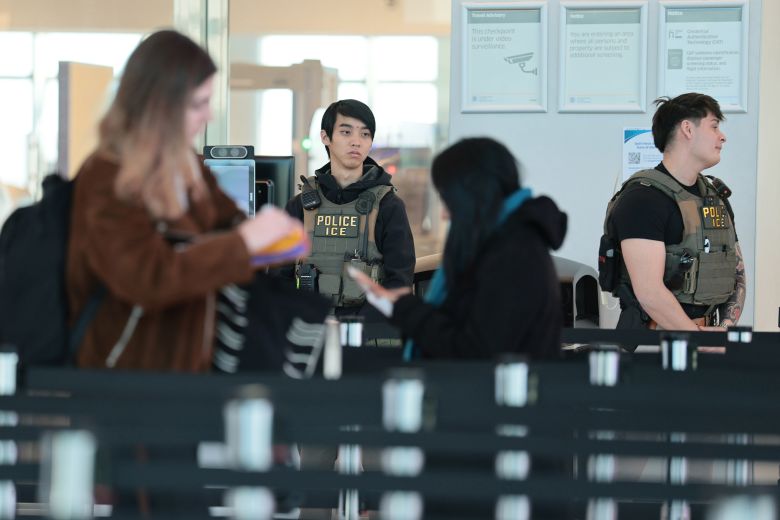
With funding having officially lapsed for the Department of Homeland Security (DHS) as of February 14th, Immigration and Customs Enforcement (ICE) Agents have been deployed by President Trump to airports around the country in a stated attempt to ease the massive flight delays and long lines that has been caused by a personnel shortage in the Transportation Security Administration (TSA).
The TSA, itself a part of the DHS, has seen its agents having gone without pay since the aforementioned February date, and the delay in regular airport function is the consequence of many of these unpaid agents failing to appear at their jobs, either being some of the now 500 agents who have quit entirely, or the thousands more who have called off for a myriad of reasons, from a genuine inability to afford the travel to work, to a protest against the present political conditions.
All of this comes as a direct result of an ongoing partial government shutdown – the second longest government shutdown of any size in the country’s history as of the time of this writing – stemming from congressional debates over appropriations of funds to the DHS. More specifically, the majority of scrutiny is directed towards the means by which the immigration enforcement agencies within the DHS such as ICE and U.S. Customs and Border Protection (CBP) have been operating, especially following the extrajudicial killings of Renee Good and Alex Pretti by ICE agents earlier this year.
As outlined in both the initially proposed funding bill by the Democrats and a letter created by Hakeem Jefferies and Chuck Schumer, the current House and Senate Democratic Leaders respectively, Democratic support of any proposed bill for appropriation of funds was conditional on the passing of a number of reforms directed towards ICE and CBP. These reforms included measures such as no longer allowing ICE agents to eschew identifying themselves, upholding stricter standards around use of force, requiring warrants be obtained before private home entries and arrests, and stopping the use of racial profiling as a form of probable cause, among others.
Republicans shut down the bill with these attached conditions, causing a chaotic back and forth as both parties have attempted to use the lack of DHS funding to leverage their own ends.
While Democrats have sought to pass an appropriation bill under the pretense of the previously stated reform measures, some Republicans, such as President Trump himself, have seen fit to attempt to use this as an opportunity to force the passage of the highly controversial Safeguard American Voter Eligibility (SAVE) Act, desiring to withhold a funding agreement until it was voted into law.
Despite this, some prominent outlets for state media, such as the DHS and White House websites, have characterized this situation as the “Democrat’s Shutdown,” placing the blame squarely on the Democratic Party’s shoulders. How effective this has been in swaying public opinion against the Democratic Party is not truly measurable, but as of today, March 27, there has been a clear ceding of most of their desired concessions, as the early hours of this morning saw a DHS budgeting bill pass the Senate with unanimous approval.
The bill returns regular funding to the DHS outside appropriations for ICE and parts of CBP, and it is now awaiting House approval before moving onto the President’ desk, with its ultimate fate remaining dubious.
Notably absent from this bill were the previously mentioned reforms to the DHS’s immigration agencies, and though the withholding of funds from them is an attempt to find some compromise amidst the chaos, especially as flight delays get worse, airport passenger congestion increases, and disasters such as the Sunday night fatal plane crash at LaGuardia Airport have occurred, it is very hard to determine how effective this compromise may be in repairing damage that has been done or avoiding future harm to those directly affected by the DHS’s operations.
This is especially difficult to gauge when taking into consideration that while TSA agents have not received any pay for weeks, ICE agents have continued to be paid – sometimes as much as twice as much as the average annual salary of TSA agents – because ICE is not reliant on the same budgetary appropriations as the rest of the DHS to keep their agents paid. Rather, given President Trump’s favor towards ICE, having used the agency in a manner that has been described by some critics as essentially a paramilitary force, last year’s One Big Beautiful Bill Act allotted the agency $75,000,000,000 over a five year period, meaning that they not only have they continued to receive pay throughout the shutdown, but likely will not have any issues with compensation going forward, even with the 2026 budgetary appropriations withheld to them for the time being.
While Congresspeople from both parties have taken pride in the Senate’s passing of the bill, the majority of political leverage on the behalf of the Democrats has undoubtedly been lost, even as members like Chucker Schumer claim it to be “exactly what we wanted.” As it stands now, Republicans are pursuing the creation of a party-line funding bill to not only secure the last of their sought appropriations to ICE and the CBP (ideally “unburdened” by any reform measures), but also further the passing of the SAVE Act, as well as secure more funds for the armed conflict in Iran, spearheaded by the American and Israeli governments.
No matter what happens, this whole conflict is one of many links in the broad, chaotic chain that has been the representative tether for our current administration’s first year in power. And though there are no certainties or easy answers promised to us in the future yet to come, an element of fearful, cautious tension still looms strongly above it all.
 Spring 2026
Leave a comment