By Cassandra Dollard
On Friday, January 30, 2026, the U.S. Department of Justice released over three million new files related to the ongoing allegations against Jeffrey Epstein and those with whom he was closely associated before his passing.
The review of this new information, which includes pictures of people in positions of power posing with Epstein in his home on Epstein Island, along with incriminating email communications between himself and many well-known people, has prompted renewed outrage and the need for the accused to be held accountable. However, Deputy Attorney General, Todd Blanche, has stated that “we had reviewed the ‘Epstein files,’ and there was nothing in there that allowed us to prosecute anybody.” “We then released over 3 1/2 million pieces of paper, which the entire world can look at now and see if we got it wrong.”
Though U.S. representatives have been granted access to analyze unredacted information regarding these files, many have discovered that their searches related to the recently released information have been tracked by the DOJ, without their knowledge. In addition, several of these representatives have accused the Department of practicing negligence when it comes to the handling of the victims’ identifying information and the obvious redaction of prominent people’s names and pictures. There are also many instances in which men’s faces are redacted and women’s are not, even though Todd Blanche made this statement at the time of the January 30, 2026, release: “We redacted every woman depicted in any image or video, with the exception of Ms. Maxwell. We did not redact images of any men unless it was impossible to redact the woman without also redacting the man.”
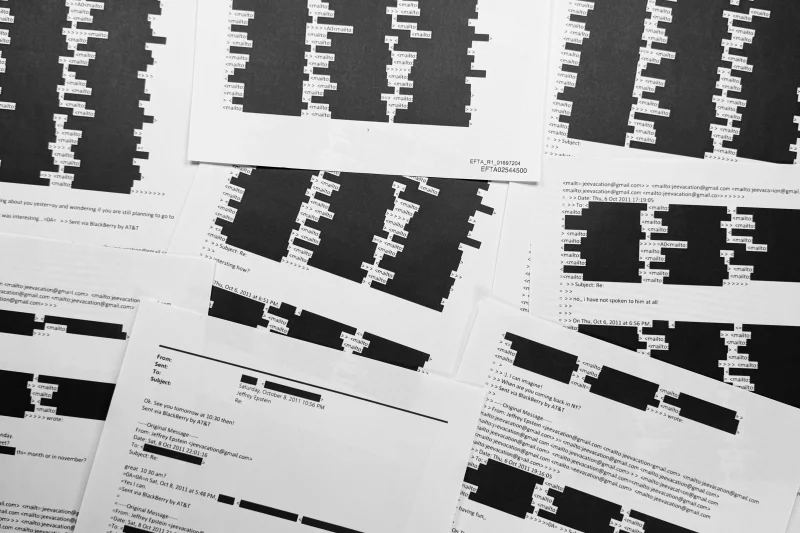
Furthermore, several representatives state that interpreting and even simply reading these new files is cumbersome, owing to the fact that there is no discernible order to the documents; many pages are duplicated, with different redactions on each one, making it difficult to discern what is actually being read. Lawmakers who are searching for and reading these documents have stated that the way in which they were handled by the DOJ is not lawful.
On August 8, 2019, approximately a month following Epstein’s arrest on July 6, 2019, for which he was charged guilty with the initiation and continuation of a sex-trafficking operation, he updated his will to reflect that the entirety of his wealth be distributed between certain associates and family members. Two days later, on August 10, 2019, he was found deceased in his jail cell. Among those who were to benefit considerably from Epstein’s wealth in the event of his death were his trusted lawyer, Darren Indyke, who signed his trust on August 18, 2019, and his accountant, Richard Khan, who signed his trust on August 20, 2019.
According to several members of Congress, both Democrat and Republican, to say that these new files have been mishandled by those within the U.S. Department of Justice would be an understatement. Attorney General Bondi testified on Wednesday, February 11, 2026, that the Department of Justice was within its rights regarding the redactions.
 Spring 2026
Leave a comment