By Brandon Davis
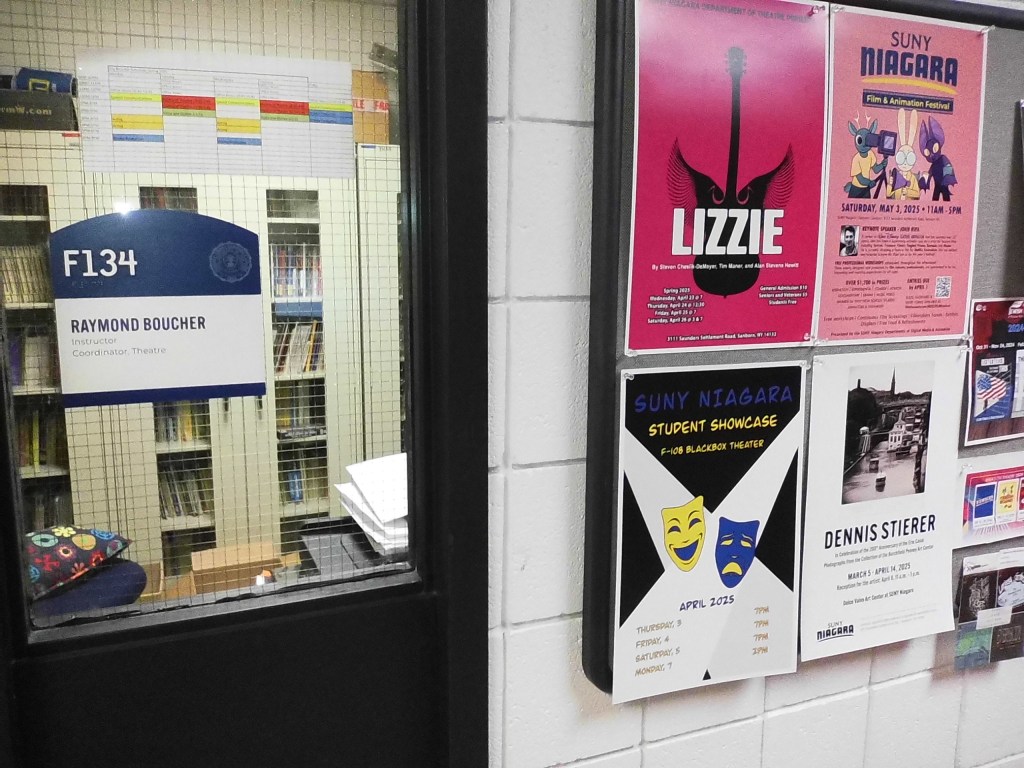
As of Late, theatre and its participants have been much maligned. Most teachers, parents, and cultural figures will try and steer many youths towards the trades or other such easily marketable certifications rather than theatre or any of the other arts. My only exposure to theatre, before coming to SUNY Niagara, was from the wider cultural perceptions of it. It is outdated and obsolete and its participants hopeless eccentrics. So, imagine my surprise when I attended a production, I believe it was Karcher’s “One Acts”, and it was fun. When I got to know the people behind the production, they weren’t wierdo eccentrics, but instead they were outgoing and hard-working students who put everything they had into each production. It was hard to believe that the perception and reality of theatre were so detached from one another. Therefore, the first person I thought of to interview for this issue was the great Ray Boucher who had originally opened me up to what theatre is all about.
What’s your favorite part of being a part of the theatre program?
Boucher: The creativity that we get to explore together, me and the students, and the growth that I get to see. You know, we are only a two-year program, but students come in at a certain level and I get to see them, a lot of it has to do with confidence, I get to see them grow into that and become strong workers when they learn what the work is and the work ethic that is involved and I get to see them come out of their shells, I get to see them really attack projects in with a growth mindset in a way that is about the project, about the process and not the product. That’s something that I think is really important is to see the understanding that, you know when I have students, for instance, start talking about how they miss, how they’re going to miss the rehearsal process because we are going into the shows that to me is a success because it means that they are understanding that it is about the growth through the process and not so much about the applause.
Yeah, I mean you’ve said before that, I think it was that, that the theatre program was more like a trade, right? You’ve said that before, it’s like a trade program.
Boucher: Yeah, I think it’s a, my mindset is that we’re a trade school, right. That I’m trying to teach, while there’s a lot of academic elements to it, things like history, things like script analysis, things like intro to theatre, but there’s most of it getting people trade ready to go out into the field if they don’t want to go on to a four year, getting ready for the four year, but also getting ready to be work ready. Which is, I’m very lucky, we’re very lucky, that we have enough connections in the local community that consistently we have students going out and working. This summer we have Jess Vriesen is gonna be in Shakespeare in the park, we have Dino, who graduated this past winter, who is going to be in Shakespeare in the park, Andy Routhier is over at the Kavinoky right now, and he’s been over at road less traveled, Jacob Slusser’s been at Jewish Repertory, I mean these are all, a preponderance of our students are getting work and I’m getting reports back that they come in with good attitudes and willingness to do the work so that makes us look good, it makes them look good, and it sets them up, hopefully, for success in the future.
How long have you been working in theatre?
Boucher: I guess, technically, since 1995. And when you say working in the theatre, I assume you mean doing it and getting paid. So, 95, we’re in 2025, that’s 30 years I’ve been working in professional theatre and as a theatre educator.
Was there anything particularly challenging about this semester? Whether it be just any of the productions that had any particular challenges or anything that you’ve run into that you haven’t run into before?
Boucher: No, this was actually a great semester regarding the productions. We’re very lucky that a teacher for us, Brendan Didio, did a wonderful job with the showcase and all the students got to learn from him for that and Lizzie was a pleasure, really from the beginning because I had such hard working students and had a really good team assembled for it and so it was, it was really, in a lot of ways an easier semester. You know, when you’re in theatre there is never an easy semester because it’s a lot of work. You know, the thing that I, that is a challenge for me, that maybe some of my colleagues don’t quite have is because of the nature of the program we’re together an awful lot, the students are together an awful lot, and so there is some interpersonal issues that come up that as artistic director, producer, director, education director, it then falls to me to sort of mediate sometimes between students, and there were no big major blow ups or anything, but every semester there is always something because, especially when stress comes and the tenson comes from putting on a show and wanting to get it right, you know, sometimes we have to sit down and say “hey, we’re not being our best selves right now are we?”. Like I said, there’s no big things, but that’s every semester. You know, that’s one of the things that I have to do is mediate those conversations because we’re trying to teach people how to comport themselves in a professional world and, as you know, even in the professional world people don’t comport themselves always in the most professional way and so I’m trying to teach best possible practices. An example I think of that is, in the booth, I think it was an ARP student was interning, that was getting some hours in the booth and they said, you know, when I came in I said “This is Dino, Dino’s the boss” because Dino is our stage manager, and this student said “Oh, Dino is the one that’s gonna yell at us”, and I said “no, no no no, not here” and the student said “that’s different from any’ you know ‘any of my experience in the past” and I said “yeah, but that’s not how we conduct ourselves in a professional setting. We don’t yell and scream at each other. We will urge you to do the work correctly, but” that’s the thing I’m trying to teach, it’s not a social club, it’s a professional venue and so yeah, you’re not always going to get along with people, that’s life, right? It doesn’t have to, you know, blow up into this, this interpersonal conflict. It, you know, needs to be dealt with in a professional way. I mean, I’ve been working since I was 11, 10 years old right, in tons of different jobs. I haven’t gotten along with everyone I’ve worked with you know, but that’s life. So, that’s what I try to teach here, that sort of work mentality that we all need to get along because we all have a common goal, our common goal is success, and we need to help each other to achieve that success.
Is there anything exciting about the theatre program’s future that you can share?
Boucher: Constant and continuous growth. The space we’re in right now, we have a potential project of turning it into a studio space that may be a performative space as well, and so looking towards as much flexibility as we can could be an exciting thing that happens. It’s still in the very early planning stages so it’s a possibility, and, you know, when you go into any new season, so we call them here at school “semesters” and “years” right, but in my theatre mind I’m looking at next season, everything is possibly exciting. I’m excited that Brendan Didio is going to be directing the main stage, and so students who have worked with him will continue to benefit from him and students who haven’t gotten the chance to work with him. Jack Hunter’s gonna do a small show for us, who is a local great. We haven’t decided on the musical for the spring yet, but that’s always a daunting and exciting prospect. I have a couple of new students coming in that I’m really excited to work with. So yeah, just everything, I guess, you know, every year is exciting to a certain extent because when you get that season mindset it’s like “okay we’re wrapping this season. Now we have to get ready for next season” right? We don’t generally, so it’s the other thing too when I look at this obviously as the educational facility is, and I have lots of work that I do as a faculty member, I have committees and stuff. So, there’s that one element of my job, and the other element of my job is when I look at it like “the season” right? As though we are a theatre company as well as a school and so I have those couple of mindsets, so it never really ends, right? You end a semester, right, and the thinking is “teachers have summers off” right? And they go and any teacher you know doesn’t necessarily, and a theatre person even more so because I’m gonna be just diving into as many librettos this summer as I can so I can be as prepared, because as a two-year school, we don’t have the luxury that four-year schools have of knowing, fundamentally, who’s coming back, right? Because it’s two years and a lot of people are graduating, right, and so I won’t know until a few weeks into the semester what kind of musical we can do in the spring. So, I can’t make that decision now. Like some schools already have the rights to whatever. I can’t make that decision until I know who we have right, and then I say, “these are the voices we have” because my goal is, obviously to teach, and its to make sure that we are making choices that are reasonable and logical for the people that we have. I don’t believe in over reach where its like “oh, where going to do les mis” like “you have five students” and “yeah we’re gonna do a five person…” we’re not gonna do that, we don’t have the orchestra for that, and so figuring out what we have with our music students, with our theatre students, and so that’s always a huge challenge and I have to start that over the summer. You know, Josh Wagner, he and I are gonna have conversations over the summer as to the different musicals we’re looking at and what we think we might be able to do and then we can make the decision in the fall and then starts the process of getting the rights. So, that’s all very exciting and daunting and stressful and fun and it’s a great challenge and you never know and that’s the other thing that, the other great thing about what we, the unique thing about what I do and my program that other of my colleagues besides the people in the arts, because if you look at the fine arts program they have these gallery showings and so this is our students work that anybody can come and see and judge right. They can judge how we’re doing. Josh has the music concerts and the musical and we have the plays that anyone can come see and say “that’s what you’re doing? Oh well” you know, or “that’s what you’re doing? That’s exciting”. I think people that walked out of the shows the last couple of years are thinking “oh, well that’s some pretty good stuff that’s going on”. But that’s, you know, again that’s the secondary kind of thing. The primary focus is the education so even you could learn as much from a bomb as you can from a success right? We want to prevent bombing, right? Nobody wants that right? But as far as the educator side of me goes, “what did we learn?” and so that’s the unique thing that’s a daunting thing is that our work is on display for everybody to see and so that’s always exciting and nerve wracking and when it comes to this culmination, Lizzie we just finished the musical, I was over the moon. I couldn’t have been happier with what happened in that production. That’s across the board. The four leads, the more ancillary characters, who are also playing production roles, you know, who are creating the look of the piece, the band, I mean all these elements coming together is great, you know, at the end of the day once we open my, you know, I house manage and I box office manage but my work with the stage is done so I just have to let it go and sometimes that hard cause if I’m sitting in the audience I cant do anything, I can just only watch and say “oh they missed a line” or “blah, blah, blah”, but they did such a great job I was very ecstatic, but then, you know, a week after its done you sorta miss your Lizzie world and two weeks in you start reflecting back and there’s always things you could have done differently “what if we would have done this? And…” but I was ecstatic with that and that’s great to feel proud like that. More than one of the students whose parents came said that their parents reported back to them that I sounded like a “proud father” and in a way that’s how I feel. Obviously, I’m like the “theatre uncle” right? Where I’m very proud because I get to see the work that they put in. Especially if we are talking about students like, well like the three students I have worked with a lot, Natalie McKnight, Vex Devonshire, and Nicole Howard who are three of the four leads right, I got to see them, I’ve gotten to see them through two years, and to see where they’ve grown in that case, and Allen who was new to us, whose an animation student, you know I got to see Allen when I first met him in acting for animators and filmmakers and said “Oh, you should come and audition” and then the growth in the three months, of course I feel like a proud dad. You know, I’m very proud of when you see someone working so hard AND achieving, it makes me unbelievable proud. That’s their efforts, right? My job is to guide them, but if they’re not gonna do the work then they’re not gonna have the growth and they did they did the work and they had the growth.
This is something about something you said earlier, what’s the process like for choosing productions each semester?
Boucher: Largely it has to do with flexibility. So, I’m gonna meet with Brendan in the next couple of weeks and he’s gonna talk to me about some of his ideas and I will say no to some of his ideas because I’ll say “well”. For the fall show, I like to think in terms of, in the fall we like to do a main stage show and we like to do a black box show. I already know the black box show that we are going to do only because Jack Hunter want’s to direct it and its two person and that’s perfect for the black box show because it doesn’t take too many people away from the main stage show, but we still get to put on a product in a different venue which I think is really important and then I like to think in terms of a cast size of six to fourteen that we can double if we need to, that we can be flexible. So, for instance, a Shakespeare can work in that because you can just cut characters out of a Shakespeare play or double them, but you know a cast size that is a reasonable cast size that we are able to do and that can be a challenging thing. I try to give everyone an opportunity to perform in some way. You know, we had the show case this past semester because we had a four lead musical and so I wanted to make sure that everyone else got some nice stage time so that they could get that experience and so that’s why I had Brendan come in and do the showcase which was great. So, to choose it I like to think in terms of our main stage show in the fall as something that I would call “classical”, not everyone would, and for me that means before the 1900’s, but I will also, if somebody says “well, I really want to do a Tennessee Williams” I’m like “ahh yeah that’s contemporary classic”. I’m pretty flexible on that if somebody has a good, if somebody who is directing has a good reason for wanting to direct it. If I were directing the main stage classical, I would probably go legit classical Greek, Roman, maybe Shakespeare, maybe someone like that, but I’m also open, Jack did “A Doll House” which fits the pre-1900’s last semester for me and so giving the students the chance to cut their teeth on classic is part of that consideration. So, when I think about the season I think in terms of classic, experimental black box, and musical, and then, like last semester, I through the showcase in there so we had four shows this year. Which is, I don’t know when the last time SUNY Niagara has done a four-show season so that was very exciting. So, yeah that’s, I didn’t really answer the question, but largely that’s, these are the factors that I think of
So, just as a final question: a lot of emphasis has recently been placed on students pursuing “practical” and more “Marketable” degrees. So, in your opinion, what is the value of pursuing theatre for students?
Boucher: Oh boy, it annoys me that theatre has had a reputation of being an unpractical, or impractical, field, it’s not at all. The practical elements that we’re learning through the course of the theatre program, I mean, people are learning how to build things for one thing, right? You’re learning lighting, you’re learning sound, and these are immediately applicable to, I mean, if we think money making, making money is so valuable, these are ways that students can make money. I mean, my students, like I mentioned earlier, are out there making some money. They’re not getting rich off of it, theatre’s not notorious for making people lots of money, but lots of things aren’t. You learn collaboration, you learn creative thinking, problem solving, these are all valuable in any field, right? I ‘ve been in, I haven’t only done theatre or education, you know, I’ve been in the business world, when I was a younger fella living in New York as a starving artist I wasn’t a bartender, I was in offices and I was hiring people, and you know, we would sit around and we would get theatre majors and you would get the resume and “they studied theatre”. Everybody, even the non-theatre people, at that table knew that there was value there, right, that those are, that it is a hard, my majors work harder than other majors, they spend more time here, it’s hard to do this, and so work ethic, real results-oriented work ethic, right? You can see the results of hard work versus you can see the failures when you don’t put in the work. So, I think it’s a very practical thing to study. Most people, let’s be honest, don’t go into the field that they studied in college. It’s a rare, it’s rare that you go into the exact field you studied in college, right? Maybe something peripheral to it. So, wherever they decide that this two year degree takes them, I think that the skills that they learn are very, very, valuable and I think that anybody who is hiring somebody who has any kind of theatrical background or knows somebody with one, knows what they are getting, its somebody who is hardworking, and can collaborate and can be creative.
Well, that’s all I’ve got for you.
Boucher: Thank you very much, Brandon
Thank you
 Spring 2026
Leave a comment