by Sarah Baase
Sex trafficking: a topic that seems to never go away. There are cases all over the world dealing with this revolting issue. More specifically though, Niagara County. Just this past November of 2024 a man in Niagara Falls was charged with sex trafficking a minor. Another headline reads, “Luxury real estate brokers charged in federal indictment with sex trafficking in NYC.”
When is the problem going to stop? When will minors stopped being bought and sold for money and pleasure?
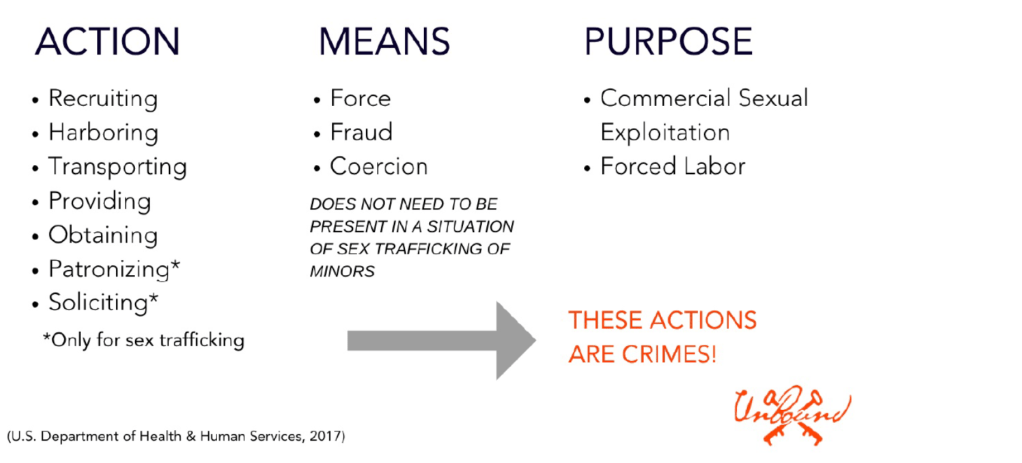
According to writer Rochelle Keyhan from the NSVRC (National Sexual Violence resource Center), there are at least 25 types of human trafficking occurring daily. However, as a solution to the problem, this writer states that instead of focusing all our attention on the victim, we must start being more aware of the trafficker themselves. Keyhan believes that using the, “Actions, Means, Purpose,” model (as seen in the picture) is a better way of understanding who these criminals are.
The question might be, “How does someone become a target for sex traffickers to begin with?” The answer to that, according to the nonprofit organization, Hope for Justice, someone who is vulnerable is more likely to be trafficked. A vulnerable person would be described as someone “who can be easily, physically or mentally hurt, influenced or attacked.” This could be elementary to middle school aged children- people who aren’t as aware of their surroundings.
This could even be students in high school and/or college. While they are much older and more aware of their surroundings, there could be certain situations to make them not so aware, like perhaps being under the influence.
During an interview with Francesca Szymanski, from the Buffalo City school district, she emphasized staff concerns regarding student trafficking. She explained that students are encouraged to seek help from trusted adults. She went further to explain that each year, staff needs to complete professional development in school violence and child abuse.
They examine the five P’s:
- Preventions
- Protection
- Provision
- Prosecution
- Participation
They understand that students need social and emotional support.
Staff, along with the building student support team and social workers meet with students to ensure safety and understanding. The student support team also provides outside resources such as Say Yes of Western New York, and counselors through endeavor.
She explained that outside services provide information to staff and students through engaging presentations. For staff, students and community members, Western New York provides engaging drug free programs. It also emphasizes the proper use of social media.
According to the article, “Human Trafficking and Social Media,” by Mary Nikkel, between the year 2000 and 2020, 30% of sex trafficking survivors in U.S federal cases were recruited by their trafficker on social media. In the year 2021, the number was 41% and today it is even higher. That should say something.
Mrs. Szymanski feels that social media has only gained popularity through the years, and will continue to, therefore, it is important to educate and monitor proper use of social media and how it plays a role in student trafficking.
 Spring 2026
Leave a comment